Indice
- Immersion cooling as a key technology in modern data centres
- Why fluid quality is critical in immersion cooling
- Particle contamination: underestimated risk for cooling performance and components
- Water in dielectric coolants - a hidden but serious problem
- Inline filtration with spin-on filter housings
- Spin-on filter elements for filtration and dewatering
- Offline filtration with bypass or "kidney loop" systems
- Filtration and water removal as a strategic decision
- FAQs

Immersion cooling as a key technology in modern data centres
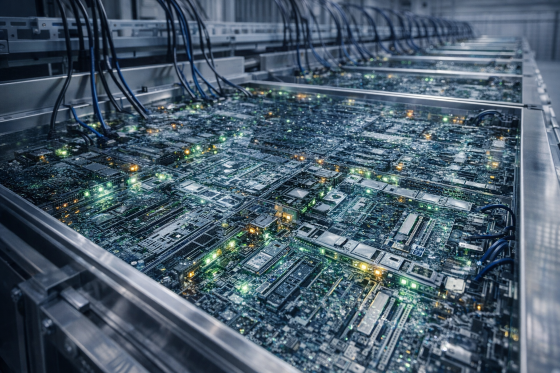
Liquid immersion cooling is becoming increasingly important in modern data centres. Increasing power densities, computing-intensive AI workloads and the need for energy-efficient cooling concepts are driving the development away from classic air or cold water systems towards liquid-based solutions.
At the centre of this technology are dielectric coolants that directly surround electronic components and efficiently dissipate heat without being electrically conductive. This makes the coolant itself a central functional element of the infrastructure - with correspondingly high requirements in terms of condition and purity.
Why fluid quality is critical in immersion cooling
Dielectric immersion cooling fluids are specially formulated to ensure several properties over the long term:
high dielectric strength
Stable thermal conductivity
Chemical compatibility with electronic components
Even small amounts of solid particles or water can have a negative impact on these properties. Unlike in classic hydraulic or lubrication applications, immersion systems work in direct contact with sensitive electronics, which means that the requirements for fluid purity are particularly high.
Particle contamination: underestimated risk for cooling performance and components
Solid particles in dielectric coolants arise from various sources, including
Production residues in containers, pipework or heat exchangers
Abrasion from pumps and mechanical components
Installation residues and sealing materials
Ageing and degradation of the fluid during operation
If these particles enter the cooling circuit, they can be deposited on electronic components and cooling surfaces, impair heat transfer and partially block narrow flow channels. Particles also accelerate the ageing of the coolant itself.
Continuous, highly efficient particle filtration is therefore required throughout the entire life cycle of the system - from commissioning to continuous operation.
Water in dielectric coolants - a hidden but serious problem
Alongside solids, water poses one of the greatest risks for immersion cooling systems. Even traces of moisture can have a significant impact:
Reduction in dielectric strength
Increased risk of corrosion on metallic surfaces
Accelerated fluid ageing
Formation of microbubbles at operating temperatures, which reduces the cooling capacity
As dielectric coolants are generally hydrophobic, water does not dissolve completely but circulates in the system in the form of free droplets. Targeted dewatering is therefore essential in order to maintain the dielectric properties in the long term.
Inline filtration with spin-on filter housings
For many applications in immersion cooling, inline filtration is a compact and space-saving solution, especially for moderate volume flows.
Spin-on filter housings from STAUFF are designed for inline installation and offer:
Single or double versions
Operating pressures up to 14 bar
Robust aluminium construction
Compatibility with spin-on filter elements for particle filtration and dewatering
They form a reliable first level of protection for pumps, heat exchangers and sensitive components in the cooling circuit. Compatibility with specific immersion coolants must be checked for each application.
Spin-on filter elements for filtration and dewatering
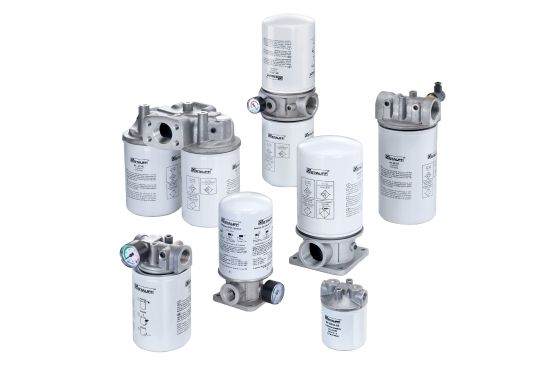
A wide selection of spin-on filter elements is available for fluid treatment in immersion cooling systems. These allow the filtration performance to be precisely adapted to the respective requirements.
Typical features are
different filter media
High separation efficiency
Large dirt holding capacity
Optional integrated bypass valves
Option of customer-specific labelling (e.g. by printing on the filter cartridge or individual packaging and labelling)
Combination of filtration and dewatering
In many applications, pure particle filtration is not sufficient. Spin-on filter elements with water-absorbing media enable the simultaneous removal of solids and free water from the coolant. They therefore make a significant contribution to maintaining the dielectric properties and operational reliability of the system.
Offline filtration with bypass or "kidney loop" systems
With increasing volume flows and growing system size, inline filter concepts reach their limits. In such cases, offline filtration systems, also known as bypass or kidney loop systems, are used.
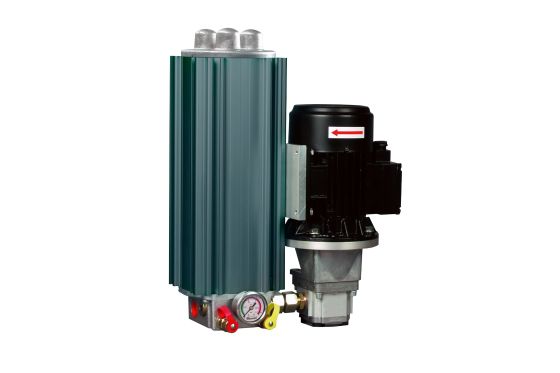
These systems operate independently of the main cooling circuit and enable continuous treatment of the coolant. Typical features are
integrated motor-pump unit
Two-stage filtration concept
Combination of microfiltration and spin-on dewatering
Simple integration and retrofitting
By continuously conditioning the fluid, Kidney Loop systems contribute to the stable long-term quality of the cooling fluid - even in large-scale data centre environments.
Filtration and water removal as a strategic decision
Filtration and water removal are not just maintenance issues in immersion cooling. They have a direct influence:
System availability and operational reliability
Cooling capacity and thermal stability
Service life of cost-intensive coolants
Protection of high-quality IT hardware
In immersion cooling systems, the cooling fluid itself is part of the infrastructure. Professional and continuous fluid maintenance is therefore a strategic prerequisite for reliable operation.
FAQs
Why is filtration so important in immersion cooling?
Filtration removes solid particles from the dielectric coolant, which can have a negative impact on heat transfer, flow behaviour and component service life. Clean coolants support stable cooling performance and reduce the risk of damage to electronic components.
What role does water play in dielectric coolants?
Even small amounts of water can reduce dielectric strength, promote corrosion and impair cooling performance. As water does not dissolve in hydrophobic coolants, targeted dewatering is necessary to ensure the fluid quality in the long term.
When is inline filtration sufficient?
Inline filtration is particularly suitable for systems with moderate volume flows and clearly defined purity requirements. It offers a compact solution for continuous particle and water removal during operation.
When do offline or kidney loop systems make sense?
Offline filtration systems are used for larger systems or higher flow rates. They work independently of the main circuit and enable continuous, particularly efficient treatment of the coolant.
Can filtration and dewatering be combined?
Yes, special filter elements with water-absorbing media enable the simultaneous removal of solids and free water from the coolant, thus helping to maintain its dielectric properties.

Newsletter subscription
Subscribe now and don't miss any new articles!